
The question is almost never “is this broken?” It is “is this broken enough?” And the honest answer in Abuja is that the point at which a plumbing problem becomes expensive arrives much earlier than most households assume, because in a property fed from a storage tank and a pump, there is no mains pressure drop to tell you something has gone wrong.
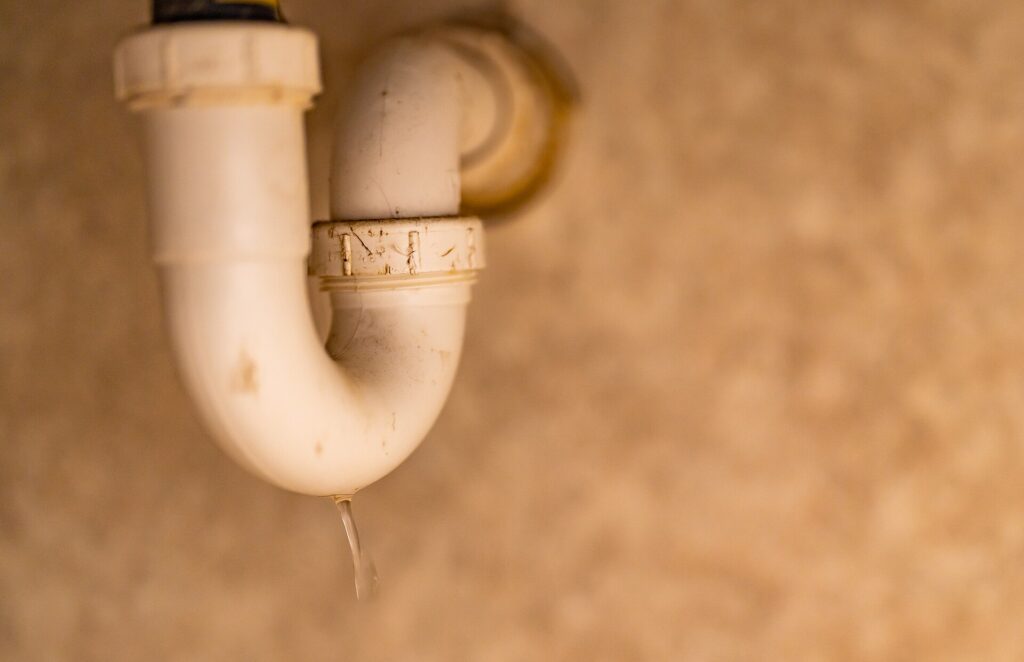
On a continuous pressurised supply, a serious leak announces itself. Pressure falls, the meter spins, somebody notices. In the tank-and-pump arrangement that is standard across 25 districts of Abuja, none of that happens. The pump simply refills the leak, and the first signal most households get is damage.
That is why the list below is organised by what it costs you to ignore, not by how alarming it looks.
Signs to stop and call immediately
1. Water is escaping and you cannot stop it
Close the main isolation valve, switch the pump off at the breaker, then call. If water is anywhere near sockets, a distribution board or light fittings, kill that circuit before you touch anything. This is the one situation where nothing else matters.
2. A ceiling is stained, sagging or dripping
A water-loaded POP or gypsum ceiling can come down without warning, and it comes down heavy. Keep people out of the room. Do not puncture it to “let the water out” unless a plumber has told you to and told you how.
3. Sewage is backing up inside the building
Foul water inside a home is a health issue before it is a plumbing one. It also usually means the problem is downstream, the main run or the soakaway, rather than at the fixture you are looking at.
4. You have no water at all and the tank is not empty
If there is water in the tank and nothing at the taps, something between them has failed. In an occupied home that is urgent. It is also usually cheap to fix, which is the good news buried in a bad morning.
Signs to call within a day or two
5. The pump runs when every tap is closed
This is the single most useful diagnostic any Abuja homeowner can perform, and it takes two minutes. Close every outlet in the house. Watch and listen to the pump. If it runs, or cycles on and off, water is leaving the system somewhere you cannot see. There is no benign explanation.
6. The pump switches on and off rapidly
Short-cycling, starting and stopping repeatedly over seconds, is normally a pressure vessel that has lost its air pre-charge. It is usually a same-visit fix. Left alone, it destroys the pump, because motor start current is far higher than running current and the motor is being asked to absorb that repeatedly.
7. Every drain in the house has slowed at once
One slow shower is local: hair at the trap. Every fixture slowing simultaneously points downstream. If it only happens during heavy rain, the likely explanation is not a blockage at all but a soakaway with no spare capacity because the surrounding ground is saturated.
8. A damp patch that dries and comes back
People treat a drying patch as a problem that resolved itself. It almost never is. Leaks change path as materials saturate and finishes swell. A recurring patch is an active leak that has found a different route.
9. A drain smell with no visible cause
A trap holds a water seal that keeps foul air out of the room. If it has evaporated in a rarely used bathroom, running the tap solves it. If it keeps happening, the trap is being siphoned empty by inadequate ventilation, which is a system fault and will not respond to cleaning.
Signs to plan a visit around
10. Pressure that collapses when a second outlet opens
Not a fault so much as a mismatch. It means your pump was specified without anyone calculating the duty point, the flow and head your household actually needs, across the distance and simultaneous demand of your property. It is very common on large plots.
11. A WC cistern that refills by itself
Silent, continuous, and in a tank-fed house it is paid for in tanker deliveries. Households routinely attribute it to a weakening borehole. Put food colouring in the cistern, wait thirty minutes without flushing, and look in the pan. Colour means the flush seal is passing.
What waiting actually costs
The plumbing repair is rarely the expensive part. In the districts we serve, the expensive part is making good: imported stone, matched tile, POP ceilings, fitted joinery. A repair that would have been straightforward in week one becomes a repair plus a ceiling plus a decorator by week six.
The pattern is consistent and it is worth stating plainly: the plumbing repair is rarely what makes a bill large. Making good the finish around it is. A concealed leak caught in its first week is a joint and a small patch. The same leak found a month later is a joint, a ceiling, a decorator, and often a stone or tile that can no longer be matched.
What to do before the plumber arrives
- Isolate. Main valve closed, pump off at the breaker. If a tank sits above the leak, close the tank outlet too, gravity does not need the pump.
- Make it electrically safe. Any circuit near water goes off first.
- Photograph everything. Before you move or dry anything. If you ever make an insurance claim, this is the evidence.
- Do not open walls. Damp shows where water arrived, not where it left the pipe. Opening at the damp patch is how one repair becomes three.
- Find your spares. Leftover tiles or stone from the original build are worth more than you think, because matching them later is often impossible.
Frequently asked questions
Can I wait until morning to call a plumber?
If water is escaping and you cannot stop it, no. If you have isolated the supply and nothing is actively getting wet, yes, and a booked visit is usually cheaper than an emergency one. The deciding question is not how dramatic it looks, it is whether water is still moving.
Is a slow drain an emergency?
One slow drain is not. Every drain in the house slowing at the same time is close to one, because that points downstream to the main run or the soakaway, and the next stage is sewage inside the building.
How do I know if a leak is serious if I cannot see it?
Close every outlet in the house and watch the pump. If it still runs or cycles, water is leaving the system somewhere. That is the most reliable home test available in a tank-fed property.
My water smells or looks discoloured. Is that a plumbing issue?
It can be storage, it can be the borehole, and it can be corroding galvanised pipework. A plumber can identify which part of the system it is coming from. Judging whether the water is safe to drink requires independent laboratory testing, which is a separate exercise and not something any plumber should pronounce on by eye.
Should I call a plumber or a pump technician?
In Abuja these overlap heavily and you want someone who covers both, because the most common misdiagnosis in the city is a supply problem treated as a pipework problem, or the reverse.
Is a dripping tap worth calling about?
On its own it is a small job. In a tank-fed house it is also stored water you paid to put in the tank, running away continuously. Bundle it with anything else outstanding and get it done.
What should I never try to fix myself?
Anything involving a water heater’s relief or electrical connection, anything on a shared riser in an apartment block, and anything where water is near electrical distribution. The consequences of getting those wrong are not financial.
How can I tell a genuine emergency from an upsell?
Ask what test proves it. A plumber who can name the test, a pressure decay, a dye test, a pre-charge reading, is diagnosing. One who cannot is guessing or selling.
Does home insurance in Nigeria cover water damage?
It depends entirely on your policy, and the distinction between sudden escape of water and gradual damage matters a great deal to insurers. Read your wording, and photograph everything before any repair begins.
What is the cheapest moment to call a plumber?
Before the damage, while it is still a symptom. Every stage after that adds making-good to the bill, and making-good in a premium finish usually costs more than the plumbing.
Key takeaways
- In a tank-and-pump home there is no pressure drop to warn you, leaks are found through damage.
- Close every tap and watch the pump: if it runs, water is escaping somewhere.
- Short-cycling is not a quirk; it is destroying the pump and it is usually a cheap fix.
- A damp patch that dries and returns is an active leak that changed path.
- Making-good in a premium finish usually costs more than the plumbing repair itself.